Description
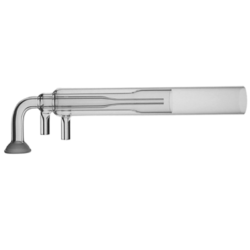
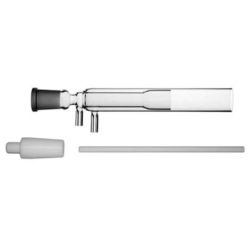
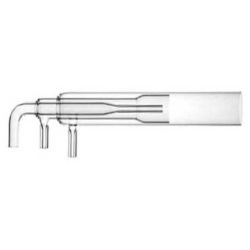
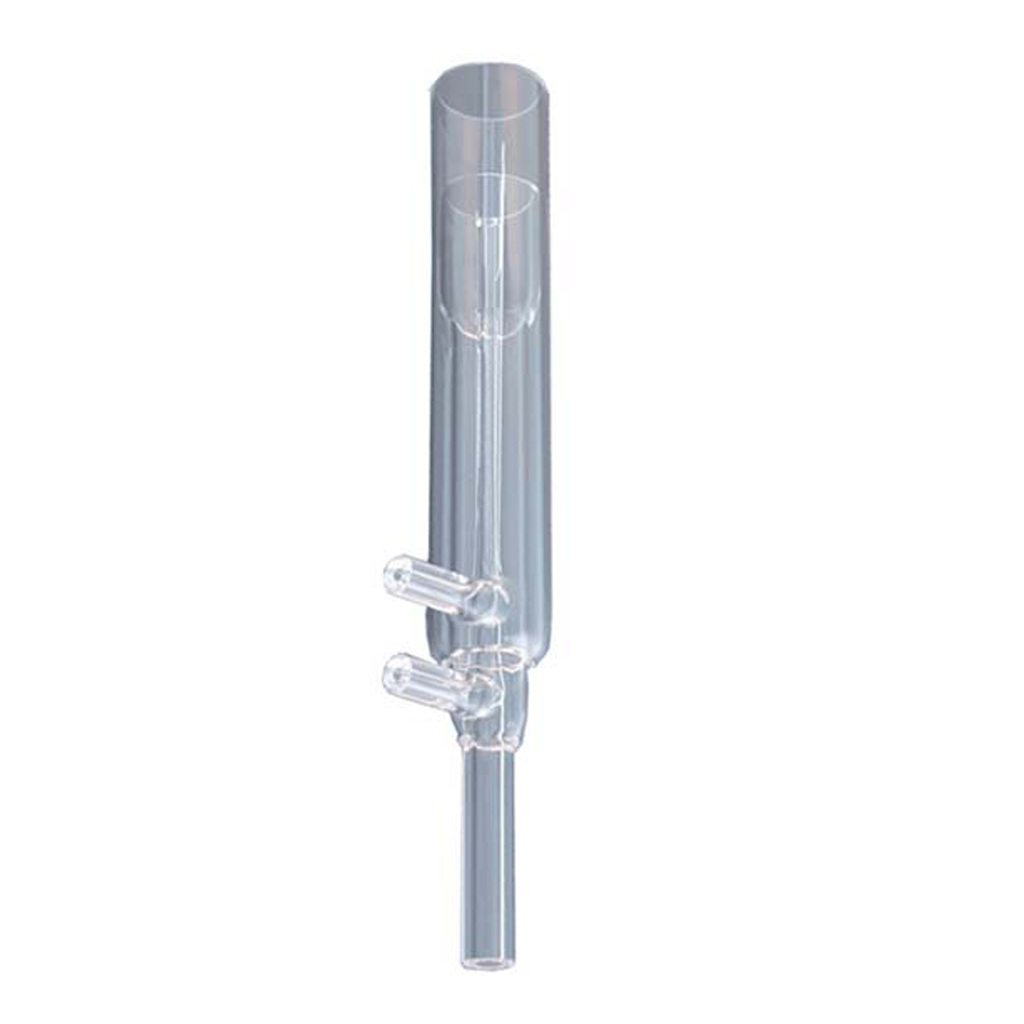
Torch Radial 1 Piece Hi Solids 800-75
Part Number:
PG800-75
Cross Reference(s)
Agilent / Varian: 2010095000
Instrument Compatibility:
Agilent / Varian 700-ES Radial Series
Agilent / Varian Liberty Radial Series
Agilent / Varian Vista Radial Series
Detail:
Radial, High Solids Torch, 1.8mm ID Injector.
What is the Role of the ICP Torch?
A plasma is an ionized gas, consisting of positively charged ions and free (unbound) electrons. The role of the plasma (ICP) in ICP-MS is to ionize the sample. In contrast to so-called ‘soft’ ionization sources in other forms of mass spectrometry, the ICP is a ‘hard’ ionization technique because it completely atomizes most molecules in the sample.
ICP-MS instruments use an argon plasma, although helium plasma is also an option. Although there are several advantages to using helium, argon is the gas of choice since the cost of helium is prohibitive.
What are the Features of the Torch?
Standard ICP Torch
Every mass spectrometer has many essential parts, but the heart of ICP analysis is the plasma torch that ionizes sample materials. The large 2.5mm injector on the standard torch gives maximum robustness and the lowest matrix interferences for the best plasma stability. The ICP torch’s purpose is to form, shape, and sustain an argon plasma that atomizes and ionizes a sample aerosol. The plasma is then fed into a mass spectrometer (MS) to detect multiple elements simultaneously. ICP-MS is a type of atomic mass spectroscopy that can quantitatively, semi-quantitatively, or qualitatively determine one or more elements in a sample. It can also measure organic solvents, detect nanoparticles, and analyze solid materials and gases.
Single Piece Torch
Single-piece inductively coupled plasma (ICP) torches have narrow bore injectors (1.0 mm or 1.5 mm) designed to improve plasma stability and reduce plasma loading when used with organic solvents. They are the least expensive type of torch to buy initially, but they are also the least versatile and must be replaced entirely if any component is damaged. Single-piece torches can also be expensive consumables that require regular maintenance and replacement, especially when used with aggressive sample matrices like hydrofluoric acid, organic solvents, and high total dissolved solids.
Do you have questions? Call Precision Glassblowing to Learn More.
Do you have questions? Visit our FAQs or Technical Information. And, there are several ways to contact Precision Glassblowing. Click here to pick one that works for you.